We were working out of a coworking space. I was at a table with a client, going through what they should and shouldn't be doing with their Google rankings, their reviews, their content, how to actually run their site. We weren't selling them SEO. We didn't offer it. I was helping out a client for free, because that is what you do.
A guy at the next table overheard the whole thing and decided I was a lead.
He pulled me into one of the boardrooms with a deck already loaded, and what he showed me was gorgeous. Revenue up. Keywords up. A client who had doubled in size. He could not explain how a single one of those numbers connected to anything his company had actually done. He took credit for growth in branded search, which is roughly like taking credit for the sunrise. He showed off keywords his client now ranked for and never once mentioned their search volume, their difficulty, or what he had done to win them. It was a pot of gold at the end of a rainbow. Walk up to it and you find a photograph of a pot of gold.
He had no idea that I used to write SEO content for a living.
I have watched some version of that pitch for years, and I am watching it again right now with a new acronym stapled to the front. GEO. AEO. LLMO. Same deck, new fonts. The difference this time is that we have the receipts, because a lot of very good people spent the last twelve months actually testing the claims, and the results are worse than I expected.
Every few years, SEO gets a new name and a new invoice
The business model is older than any of us. An ex-agency employee described it on r/SEO better than I could:
"Once in a while a new term comes out and then they sell it to the customers as a service. Ta da. $500/month. I worked for an agency and we even had our own teams coming up with 'new' services yearly based on terms no one has ever heard."
Ryan Jones put his finger on why it keeps working, and it has nothing to do with technology: "'we need more $$ for SEO' falls on deaf ears with the C suite. 'We need more money to invest in this new thing' is more understood." The acronym is a budget unlock.
It works on buyers, too. Somebody posted on r/SEO recently that they had spent $4,200 with an agency that said it did AEO, and four months later went to look at what had actually been delivered. Backlinks and meta descriptions. That was it. The top reply was one line: "I'm not charging enough."
So let me be fair before I get mean, because I have been unfairly cynical about this in the past. The good SEO people are genuinely, seriously good, and I have seen their work up close. The tenets they all share are boring and unglamorous: real reporting, real accountability, the willingness to be blunt with a client, and the spine to show up when the numbers are bad. Those people exist and they are worth every dollar. This article is not about them. It is about the ones who have discovered that a new three letter word lets them sell the same nothing at a markup.

Does llms.txt actually do anything?
No. Not for search, not for AI answers, not for whether ChatGPT recommends you. This is now measured rather than argued about, which is a nice change.
The 137,000 site autopsy
In June, Ahrefs went and looked at the server logs of 137,210 domains to see what was actually happening to these files (their full study is here). 28% of those sites publish an llms.txt. 97% of those files received zero requests in May 2026.
The detail that finishes the argument: no AI bot ever requested an llms.txt that didn't exist. They never come looking. The file is not something they check for and fail to find. It is not part of their world at all.
Reboot Online ran the cleanest test of the lot (methodology here). They published brand new pages with no internal links and no external links, so the only route to them anywhere on the internet was a hyperlink inside a freshly created llms.txt. They picked domains that AI crawlers demonstrably visit. Then they waited three months. No AI bot visited the pages. The crawlers kept happily crawling everything else on those sites the whole time.
So who is reading your llms.txt?
Of the requests those files did receive, the single biggest source was SEO audit tools.
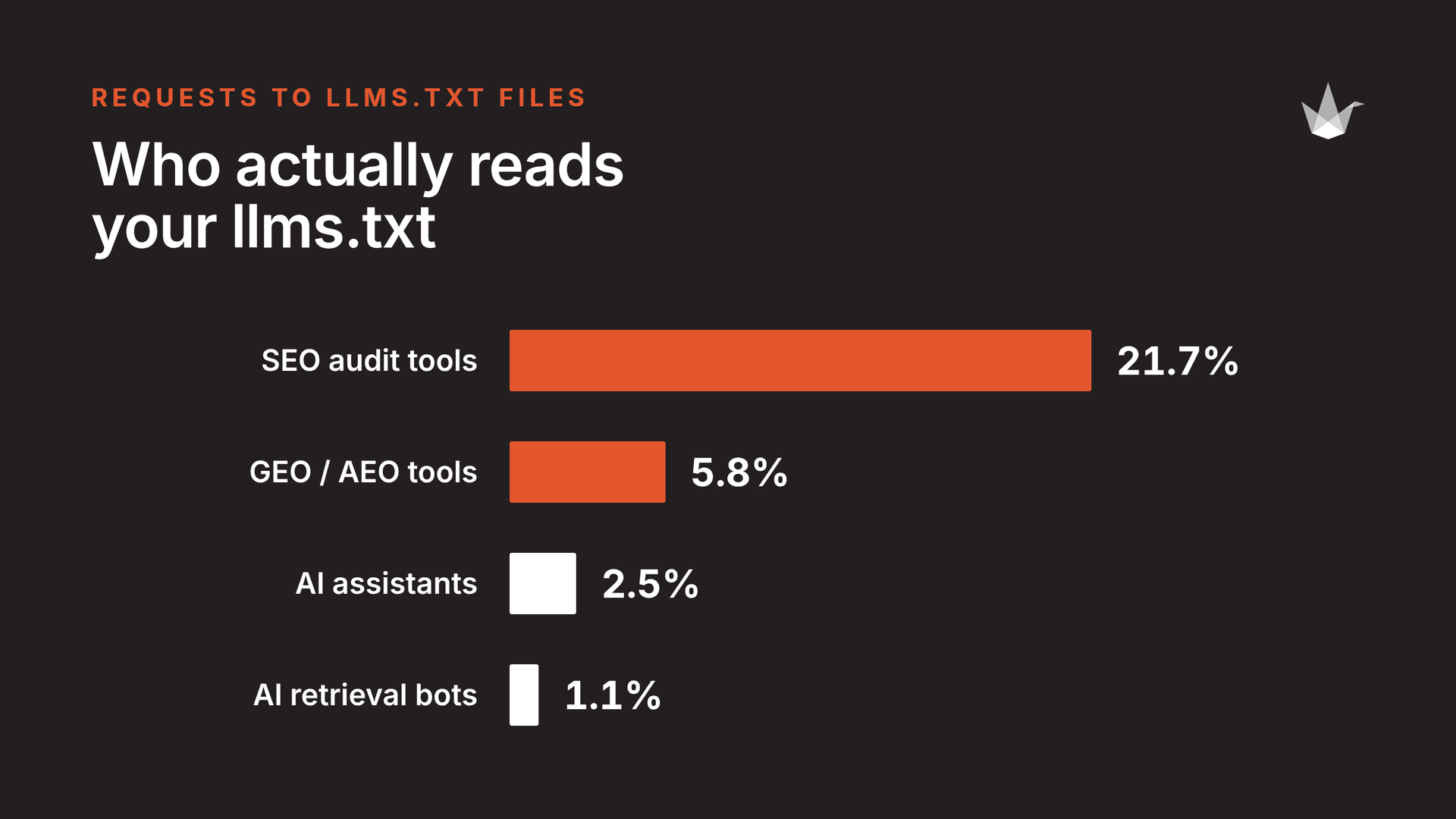
Add the GEO and AEO tools studying the file and you get 27.5% of all traffic to llms.txt coming from the software industry that sells you the file. The AI assistants and retrieval bots it supposedly exists to serve came to 3.6% between them. And the loop closes properly, because in July 2025 Semrush added a "Llms.txt not found" check to its Site Audit, warning that without one your site "risks being misrepresented by AI systems." Yoast will generate the file for you and refresh it weekly.
The tool invents the problem, the plugin ships the fix, and then the tool comes back to read its own homework. There is no AI anywhere in that circle.

The honest case for llms.txt, and why we still ship one
Most takedowns skip the next bit, and it matters. Jeremy Howard proposed llms.txt in September 2024 and he never claimed it would rank you. He built it so that an AI agent already working with your site could get a clean map of it without burning its context window parsing your navigation and your cookie banner. For that, it works. Anthropic publishes one for its own developer docs. In Ahrefs' data, Claude Code out-fetched every AI retrieval bot, every AI assistant, and every AI training crawler.
Anthropic publishes an llms.txt. Anthropic has never once said it reads yours.
This is also why Google looks like it is contradicting itself, and it is worth getting right rather than dunking on. Chrome's Lighthouse ships an llms.txt audit in an experimental "agentic browsing" category, and its docs say that without the file, "agents may spend more time crawling the site." Meanwhile Google Search says it ignores the thing entirely. John Mueller settled it himself: "The short answer is that it's not done for search. There's more to websites than just SEO :-)" Chrome is building for agents that have already arrived and want to use your site. Search is building for retrieval. Those are different problems, and the GEO industry sold the gap between them as a secret.
For the record, if you skip the file, Lighthouse marks it not applicable. It does not fail you.
So here is my confession, and it does not flatter me. Paper Crane ships an llms.txt on our builds. We know 97% of them are never read. We do it partly for the legitimate reason, which is that coding agents genuinely fetch these and it costs us nothing. And we do it partly for a reason I am not proud of: if we don't, some guy with a checklist walks into our client's office six months later, notices it missing, and calls it malpractice. He will not sit us down and ask whether we agree with him. He will just tell the CEO we missed something.
We ship it, we don't bill for it, and we don't call it SEO. That is the line, and I would encourage everyone selling this to draw it in the same place.
The demand is so completely manufactured that the skeptics comply. I am the evidence for my own article.
Google has now said this three separate ways
Gary Illyes said it out loud in July 2025: "Google doesn't support LLMs.txt and isn't planning to," and to show up in AI Overviews, "simply use normal SEO practices. You don't need GEO, LLMO or anything else" (reported by Search Engine Land). Mueller has repeated it for a year, most recently pointing out that the file has existed for years and "none of the AI systems use it" (via SEJ). He compares it to the keywords meta tag, which is about as cutting as Google gets.
And then they wrote it into the documentation. From Google's own AI optimization guide, updated two days before I published this:
"You don't need to create new machine readable files, AI text files, markup, or Markdown to appear in Google Search (including its generative AI capabilities), as Google Search itself doesn't use them."
"From Google Search's perspective, optimizing for generative AI search is optimizing for the search experience, and thus still SEO."
The same guide tells you that structured data is not required for generative AI search and that there is no special schema you need to add. Then, if you are considering third party AEO or GEO advice, it links you to Google's page on how to evaluate whether an SEO is worth hiring. That is an accusation, sitting in the documentation, permanently.
The paper the entire industry is named after
GEO is not a metaphor. It is the literal title of an academic paper: Generative Engine Optimization, Aggarwal et al., KDD 2024. Every deck you have ever been shown cites it as "a Princeton study found a 40% visibility lift."
Here is what that paper actually did. It ran in late 2023, against GPT-3.5-turbo, on a generative engine the authors built themselves. The 40% is a relative gain on a metric they invented, called position adjusted word count, which measures how much of your text ends up inside a generated answer. It says nothing about traffic, or conversions, or revenue.
And the advice that came out of it, the stuff that actually won, was this: cite your sources, quote experts, add statistics, and write fluently. That is a description of competent journalism, and it has been the job since long before anyone needed a three letter word for it. The one tactic in the paper that clearly failed was keyword stuffing, a result the marketing world has managed to leave out of every summary.
Then somebody checked. In May 2026 a team at Sprinklr ran 252,000 controlled trials across six models, testing 18 content factors one variable at a time with the source ordering counterbalanced (the paper is here). Content structure and formatting had a negligible effect. What actually decided citation was topic relevance, having a price on the page, a recent timestamp, and what position the document happened to be in when it got retrieved.
The whole checklist you are being sold, the chunking, the answer-first blocks, the semantic sectioning, was tested a quarter of a million times and came back as noise.
What actually gets you cited, and it is not your website
In June, researchers looked at 102 brands across 102,025 AI responses (study here) and found that 2.9% of AI citations point at the brand's own domain. The other 97% point at somebody else's page about you. They also found that a brand's stature alone predicted visibility: global brands showed up 73% of the time, mid-market 44%, small businesses 11%.
Ahrefs' correlation work says the same thing from a different angle (75,000 brands): branded web mentions correlate with AI Overview visibility at 0.664, while backlinks manage 0.218. Correlation, not causation, and they say so themselves. But every serious measurement points off your site and out into the world.
Last week Ahrefs published 34 promotional pages of their own and tracked 9,886 AI answers (the experiment). For their established product, 94% of the new mentions came from third parties rather than their own optimized pages. And 43% of the citations to their pages recommended a competitor in the same answer. The AI read their page, cited their page, and then told the user to go buy something else.
So content is not king. Brand is king, and most of what determines whether an AI recommends you was decided long before you hired anybody.

That sounds like a counsel of despair, and it isn't, because publishing is the only lever most businesses actually own. You cannot buy brand stature at $3k a month. What you can do is make it cheap to say something. Every LinkedIn post that gets you mentioned somewhere needs a thing to link to. Every YouTube video needs a subject. Every conversation someone has about you in a Slack channel or a Reddit thread started because you put something into the world worth repeating. The service page you never launched because updating the site was a nightmare is a service nobody is going to talk about. This is why we spend so much of our time on the boring infrastructure of a website, and why our clients can publish without calling us. Not because a crawler rewards it. Because a business that cannot publish cannot build a brand, and brand is the thing the machines are actually reading.
The metric does not survive contact with statistics
Rand Fishkin and Gumshoe ran 12 prompts past 600 volunteers, 2,961 times (the research). The odds of ChatGPT giving you the same list of brands twice are less than 1 in 100. Getting the same list in the same order is closer to 1 in 1,000. His conclusion: "any tool that gives a 'ranking position in AI' is full of baloney."
In June, a statistician put a number on how many samples you would need to say anything at all. Depending on the engine, a usable 95% confidence interval takes 40 to 150 runs of a single prompt (arXiv, June 2026). Below that, in his words, "many apparent differences between domains fall within the noise floor of the measurement process."
Now go and look at what you can buy. Semrush's AI toolkit sells you 25 prompts with "daily AI rankings" for $99 a month. One run, per prompt, per day.
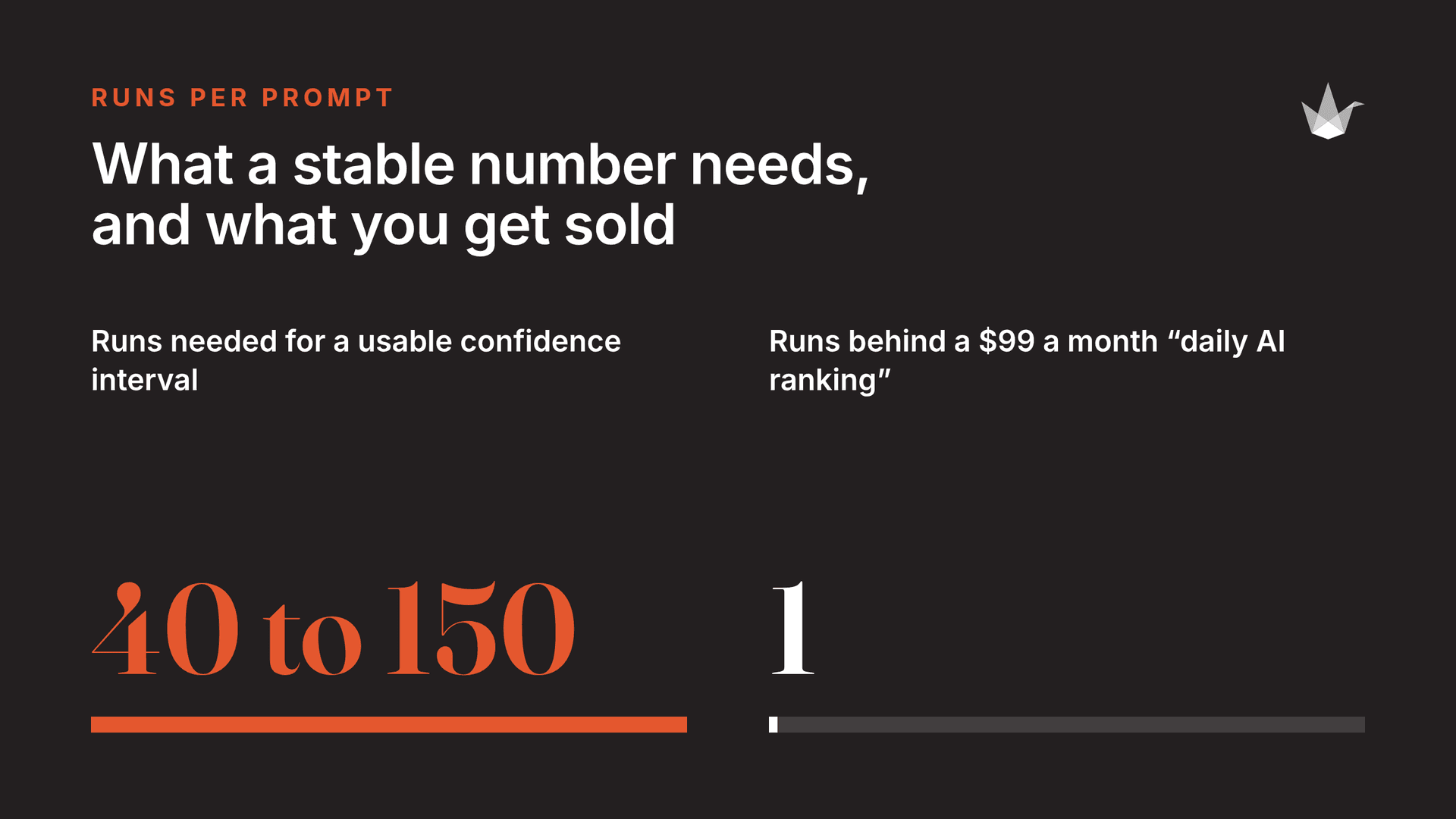
That is a rank, computed from a sample size of one, for a quantity that provably does not repeat, sold monthly, inside a company that Adobe just bought for $1.9 billion while explicitly naming GEO as the reason. And when somebody manually audited a competing tool, Ahrefs' Brand Radar, it reported 3 ChatGPT mentions where a hand count found 123. A 40x undercount. Two tools that disagree by that much on the same brand in the same week are opinion generators with a chart on them.
On May 7th, OpenAI moved a link, and every GEO dashboard went vertical
This is my favourite fact in the whole pile. On May 7, 2026, OpenAI changed how prominently ChatGPT surfaces links in its answers. Similarweb measured referral traffic to websites jump 157.7% week over week, with referrals to homepages up 354.7% (their analysis). It never came back down. That is simply the new baseline now.
No one's content did that. No schema, no llms.txt, no retainer. A product manager in San Francisco adjusted a link treatment on a Thursday.
Every AI visibility report sent to a client that month showed a hockey stick. I have not found a single vendor who wrote the words "this wasn't us."
Which is the point. You are being invoiced monthly for the illusion of control over a system whose owners can move your numbers 150% by changing a stylesheet, without telling you, without asking you, and without any obligation to keep it that way.
You may be paying somebody to get you banned
"Reddit seeding" is now a standard line item on GEO retainers. Go and plant helpful-looking comments recommending the client, because Reddit is the most cited source in AI answers. It is a real observation and a terrible plan. Reddit is now removing roughly 25,000 planted posts and comments a day, using detection that looks for artificial hype from the moment an account is created (eMarketer).
Google is watching the same behaviour. In May, Gary Illyes warned that buying brand mentions to influence AI answers is paid links, and will be treated as such (Search Engine Roundtable). Lily Ray has been documenting how these tactics actively damage the SEO you already have, which is a special kind of value for money: pay a retainer, lose ground.
Where "just do SEO" breaks down
I would be doing exactly what I am accusing other people of if I stopped here, because the strongest argument is on the other side and it deserves saying properly.
"Rank well on Google and the AI will cite you" is getting less true every month. In July 2025, 76% of AI Overview citations came from pages ranking in Google's top 10. By March 2026, Ahrefs measured 38% (863,000 SERPs, 4 million URLs). Around 31% of cited pages rank nowhere in the top 100 at all. BrightEdge puts the top-10 overlap at closer to 17%.
It gets worse for the tidy version of my argument. Kevin Indig sampled 20,000 prompts and found that 91% of AI citations appear in only one engine. Only 2.37% show up across ChatGPT, Perplexity and AI Overviews for the same prompt. Those are three mostly separate distribution systems that occasionally agree with each other, and treating them as one leaderboard is wishful thinking. ChatGPT's live retrieval also leans on Bing, which means a good chunk of the industry is optimizing for the wrong index.
I should also name my own conflict, since I am demanding that of everyone else. A lot of the best skeptical research here comes from Ahrefs, and Ahrefs sells a rank tracker. A world where AI visibility is a genuinely separate discipline is a world where their core product is a legacy dashboard. They have an interest in the conclusion "it's all just SEO." The reason I still trust the work is that they also published the study showing citations decoupling from rankings, which damages their own position, and BrightEdge, with the same incentive, published a number that is worse still. People who publish against their own interest are the ones worth reading.
So the honest version of my thesis is narrower than my original rant, and I would rather narrow it myself than have someone do it for me. The discipline is real and it is changing. The market selling it is largely fraudulent. Those are different sentences.
I got some of this wrong
Nine months ago I posted a list of the fundamentals that actually matter. People shared it. Then I went and checked it against everything published since, and parts of it do not hold up. So, publicly:
What I would cut
- FAQ schema. Google deleted the FAQ rich result documentation on June 12, 2026. The feature is gone. I was recommending a tactic for a box that no longer exists. There is an FAQ at the bottom of this page, and our site will happily emit the markup for it, because it costs nothing and Bing still reads it. But it is there because those are five questions people actually ask me, and I would have answered them whether or not a machine was watching. That is the whole distinction.
- Question-driven structure, as a ranking play. Sprinklr's 252,000 trials found formatting negligible. A separate study found Q&A formatting scored 5.74% worse on citation influence. Keep writing in questions if it helps a human find their answer, which it does. Stop telling people it gets them cited.
- Accessibility as an AI tactic. There is no evidence that WCAG conformance affects whether an AI cites you. None. The claim traces back to people misreading a factor called "URL accessibility," which means the page returns a 200 and isn't blocked in robots.txt. It has nothing to do with screen readers. Do accessibility work because it is right, because it is the law, and because disabled people use your website. That is a complete argument on its own. It does not need a robot to validate it.
What I would add
- Put your prices on the page. One of the four strongest factors in the Sprinklr study, with an odds ratio in the thousands, across every model tested.
- Render your content on the server. If your text only exists after JavaScript runs, there is no good evidence the crawlers are seeing it.
- Do not block the bots by accident. Blocking GPTBot does not block OAI-SearchBot. They are different agents with different jobs, and if you block the wrong one you vanish from ChatGPT's search answers while still feeding its training. Almost nobody knows this.
- Check that you exist in Bing. It is the index ChatGPT reaches for. Most people have never looked.
- Keep the recency honest. AI-cited pages average 1,064 days old versus 1,432 for Google's top 10 (Ahrefs). Fresher, yes. But the average cited page is still nearly three years old, and they explicitly warn against over-updating. A real "last updated" date on a page you really updated is a signal. Flipping the date to trick a machine is a lie with a timestamp.
How to tell if your SEO or GEO person is any good
The good ones already do all of this, which is how you can tell. Set the KPIs before the work starts and hold everyone to them, including yourself. Get a live dashboard you can open at 2am without asking permission, and make sure every report they send links back to it. Expect flat quarters. Expect campaigns that simply do not work, because some of them do not. Anybody promising you immediate results is telling you they have never done this.
And then, the questions the last year has earned:
- "What is the llms.txt for?" If they say it helps you rank or get cited, you have learned everything you need to know in nine seconds.
- "How many times do you run each prompt?" If the answer is once a day, they are selling you a number that means nothing.
- "What result would convince you that you failed?" Anyone doing real work has an answer. It is the single best question on this list.
- "Show me a losing month." Everyone has them. The ones who cannot produce one are cherry-picking, and you are looking at the cherries.
One more, for the people buying the research rather than the retainer. The statistic everyone quotes at you, that 94% of CMOs are increasing their AEO investment, comes from a survey run by Conductor, who sell a GEO platform, in which 73% of the respondents already described themselves as advanced at AEO, which produced a 97% positive impact rate, gated behind a lead capture form, and then syndicated as paid partner content on an industry publication. It is an ad with a bibliography.
The part that actually costs you
Everything above is about wasted money, and wasted money is the least of it.
Not long ago we were lined up to rebuild the website of a client we had worked with for years. People inside that company went to bat for us with their C-suite. We lost it. They told us why: the other agency talked about AI search more than we did.
They talked about it more. We build for it better. They got the job.
We walked into that room and described what we would actually do. Somebody else walked in and said the magic words, and the magic words won. That is the real cost of a manufactured standard. It drains a budget, sure, but mostly it moves the work quietly from the people who know what they are doing to the people with the better vocabulary, and the client ends up with a worse website and a text file nobody will ever read. I have written before about AI reshaping who actually gets to do this work, and this is the grubby version of it: not the best builders winning, just the best pronouncers.
So let me hold myself to the standard I have spent this whole article demanding of everybody else. Here is what would prove me wrong, and I will put it at the top of this page if it happens:
If OpenAI, Anthropic, Google or Perplexity publicly documents that it reads llms.txt as a retrieval or ranking signal, I am wrong, and I will say so here.
Until then, put a price on the page, publish something worth arguing with, and ask the next person who pitches you what number would make them admit they had failed.
If they cannot answer that, you already have your answer.
How we do this work for clients: AI search visibility.