Per-seat pricing is on its way out, and I will not be attending the funeral.
Let me tell you how Vercel spends its time. We add a developer to a client's project. That developer pushes code. Because they don't have a paid Vercel seat, the deploy fails. So someone who does have a seat goes to redeploy it, and Vercel quietly adds the other developer to the team and starts charging us $20 a month for the privilege. Not for more builds. Not for more bandwidth. For an account to exist.
To undo it, we run a little ceremony. The licensed developer pulls the other person's changes, tacks on a meaningless commit, and pushes it from their own account so Vercel doesn't notice a stranger touched prod. That is the workaround. That is where we are.
You are not paying for value. You are paying for permission. Once you see per-seat pricing for what it is, you can't unsee it.
What does another seat actually buy you?
Nothing that costs the vendor a cent. That is the whole problem. When you add a seat to most SaaS tools, your bill goes up by a fixed amount and your actual capacity goes up by one login.
You don't get double the storage. You don't get double the compute, the bandwidth, the API calls, or the automation runs. You get one more human who is now allowed to submit a form, view a dashboard, or push to prod. The price climbs. The thing you are buying does not.
Compare that to the stuff that genuinely costs money to run. Send twice the emails, store twice the data, run twice the queries, and a usage-priced vendor charges you more because it costs them more. That is fair. Nobody rages about their AWS bill scaling with what they use. People rage about per-seat because the meter is bolted to the one number that has nothing to do with cost: how many people you employ.
The real crime is seats stacked on feature-gates
Per-seat on its own is a blunt instrument. Per-seat plus per-feature is a business model built on making you pay twice for the same people.
The trick is simple. Put the features everyone eventually needs one tier up. Charge per seat on that tier. Now you pay more per head, for the same team, to switch on things that cost the vendor nothing.
Monday.com and the art of the triple-dip
Monday was our first real project management system when we started the agency, so I have some scar tissue here.
You would start on the cheap tier, around $12 a user. Grow the team, pay more, that is the deal, fine. Except the features you didn't think about on day one, things like email integration, the API, certain automations, and notifications, were gated one tier up. So the day you needed one of them, and you always eventually need one of them, you didn't buy that one feature. You moved your entire team to a plan that cost roughly twice as much per user. One person needed to do one thing slightly better, and everyone's seat doubled.
Then they pulled the move that made me question my own memory. Monday had a genuinely great CRM template baked into the product: boards, automations, lead tracking, onboarding flows, the works. We ran our agency on it for a long time. One day I am sitting with a client, recommending it, and it is gone. There is a CRM template in its place, but it is a hollow, near-useless version of what used to be there. I thought I had imagined the good one. I had not.
Monday had broken the CRM out into an entirely separate product with its own per-seat pricing. So a team already paying Monday per seat, on a premium tier, now had to spin up new accounts on Monday CRM and pay per seat all over again for something that used to ship as a template. Build a good feature, watch people love it, then sell it back to them at a markup. That is the Monday playbook, and it is exhausting.
HubSpot: pay per seat, then pay to unlock the basics
HubSpot catches the most clients, because HubSpot markets like a company that has never once lost a marketing argument. For years it was THE place to be.
Most of the HubSpot users we have worked with (we used it ourselves for a stretch) touched maybe 5% of what they were paying for. But they would get walked up the tiers for one small thing that should have been in the plan they already had. When we were on it, editing the status columns in your own deal pipeline was gated. Rearranging a few labels on a board you already pay for, behind an upgrade. Sales Hub Starter is per seat, Pro jumps to around $90 a seat and stacks a mandatory onboarding fee on top. We have moved clients off HubSpot, where they were spending thousands a month to use a handful of features, onto focused tools that cost pennies on the dollar and do only the things they need.
Airtable and the $20 conditional button
We loved Airtable, right up until we didn't. We rebuilt our internal PM system and CRM on it specifically to escape Monday's tier games, because early Airtable was close to one flat rate per user. Here is a database, here are some automations, go. Then they discovered tiers too.
The one that got us was conditional visibility in their Interfaces, the ability to show or hide elements based on who is looking. We didn't want junior team members seeing financial data on a page that otherwise made sense for them to use. On the lower plan you couldn't hide a field by role, so we rebuilt the same interfaces over and over inside gated accordions and workarounds, showing basically the same information minus the parts we needed to control. To do it properly you go from Team at $20 a seat to Business at $45 a seat, more than double, per user, across your whole org. Business is also where Airtable parks SSO, two-way sync, and real admin controls. Roughly $20 more per seat for a conditional button. That conditional button is a microcosm of the entire industry.
Why pay full price for someone who logs in once a month?
Because per-seat charges you for accounts, not usage, and it treats every account the same. Some of your users live in the tool. Most poke it once a month to approve something or read a dashboard. You pay the same for both.
The developer who runs Flipper Cloud said it better than I can when they scrapped their own per-seat pricing: “All seats are not equal. But there is no reflection of that in nearly all per seat pricing.” They called the model equal parts clumsy and greedy, which is about right.
It also taxes the one thing collaboration is supposed to reward: adding people. There is a comment on Hacker News I think about often, from someone running a ten-person business: “I still have to decide if my 11th new employee is worth $1000/yr for their seat, if I should kick someone else off and give it to the new employee.” That is the pricing making your team smaller in your head.
It got worse for us the moment clients entered the picture. We would want to bring a client's people into a shared portal, their PM boards, their CRM view, the relevant docs. A board of directors, a CMO, a couple of content writers. On per-seat pricing, giving one client's team access to their own project could run hundreds to thousands of dollars a month, per client, depending on the size of the org. So we did what everyone does. We built janky front-ends on third-party platforms that used Airtable as a database and displayed the data. Pure chaos, all to dodge seat fees.
The shape of the pain shows up everywhere once you know it:
- Seat creep. Every new hire becomes a line-item negotiation instead of a login.
- The SSO tax. Basic security like single sign-on and enforced MFA gets parked behind the enterprise tier, so you pay per head to not get breached. There is a running joke among sysadmins about Atlassian charging extra per user just to enforce MFA.
- Password sharing. Teams quietly share one login across ten people because the honest option costs a fortune, which is a security hole the pricing created.
Isn't per-seat pricing at least predictable?
It is, and I am not going to pretend that doesn't matter. This is the one genuinely good argument the model has.
Your bill is headcount times a number. Finance understands headcount. Procurement understands headcount. As one commenter put it while defending the model, “per-seat pricing is easy to budget for because it's directly tied to headcount… something non-technical people in finance and procurement understand.” A CFO can forecast a per-seat bill in their sleep, and there is real value in a number that doesn't surprise you.
My problem is that predictable-for-the-buyer optimises the wrong thing. You get a bill you can forecast that is predictably disconnected from what you use. And the “usage pricing is scary and unpredictable” rebuttal cuts both ways. Ask SaaStr, who cut their Salesforce human seats by 80% and watched the bill climb 83% anyway once AI agents started hammering the system. Bill shock is not unique to usage. Good usage pricing ships with caps, alerts, and hard limits, so the predictability problem is solvable. The “you pay the same whether you use it or not” problem is the design.
Why is per-seat pricing dying now?
This model has annoyed people for years, so why call it now? Two things changed.
First, rebuilding got cheap. Not free, not trivial, but cheap enough to be a credible threat. When we moved our Airtable setup to a bespoke build, the math stopped being close, and I will get to the numbers below. “We'll just build it” went from an empty bluff to a line item, and vendors can feel it.
Second, and bigger, the work is coming loose from headcount. When an AI agent does a job a person used to do, the seat stops meaning anything. a16z said it flatly at the end of 2024: per-seat is no longer the atomic unit of software. If your support team shrinks because agents resolve half the tickets, you buy fewer support seats, and the vendor's revenue drops for reasons that have nothing to do with the value they deliver. That is why Salesforce, Intercom, and Zendesk are all scrambling toward pricing based on actions and outcomes instead of chairs.

The numbers back the shift. In a single year, pure seat-based pricing fell from 21% of software companies to 15%, while hybrid models jumped from 27% to 41%. And the waste per-seat generates is grim: across the SaaS a typical company buys, 36% of licenses sit completely unused, with median software spend now around $9,455 per employee per year. A third of your seats are paying for nobody.
What actually replaces per-seat pricing?
Software priced on what you use, with an honest margin on top. I want to be careful here, because “usage-based” has already been hijacked by the same people who ruined per-seat.
Forget usage versus seats for a second. The question that matters is whether the pricing is aligned or extractive.
Aligned pricing means the vendor makes more money when you use the product more, which only happens if the product is good. That incentive points the right way. They win by making it better, so more of your team reaches for it, so the meter runs. Intercom now charges $0.99 for each issue its AI actually resolves. Whatever you make of the number, the interest is aligned. They get paid when the thing works.
Extractive pricing is per-seat and feature-gating wearing a fairness costume, and it includes plenty of “usage” pricing too, so don't let the label fool you. Ahrefs rolled out a credit system in April 2024 where opening a report or applying a filter burned credits, and people ran out mid-cycle and got charged more. The backlash was loud enough that Ahrefs walked it back for its higher tiers within two months. One of the top SEO threads about the change is titled, and I am quoting the real title, “Anyone else pissed off by Ahrefs pricing structure?”. Credits that expire, meters you can't predict, features held hostage: same game, fresh coat of paint. The test is simple. Does the vendor make more money by making the product better, or by making it stingier?
So we rebuilt ours, and here's what to do if you can't
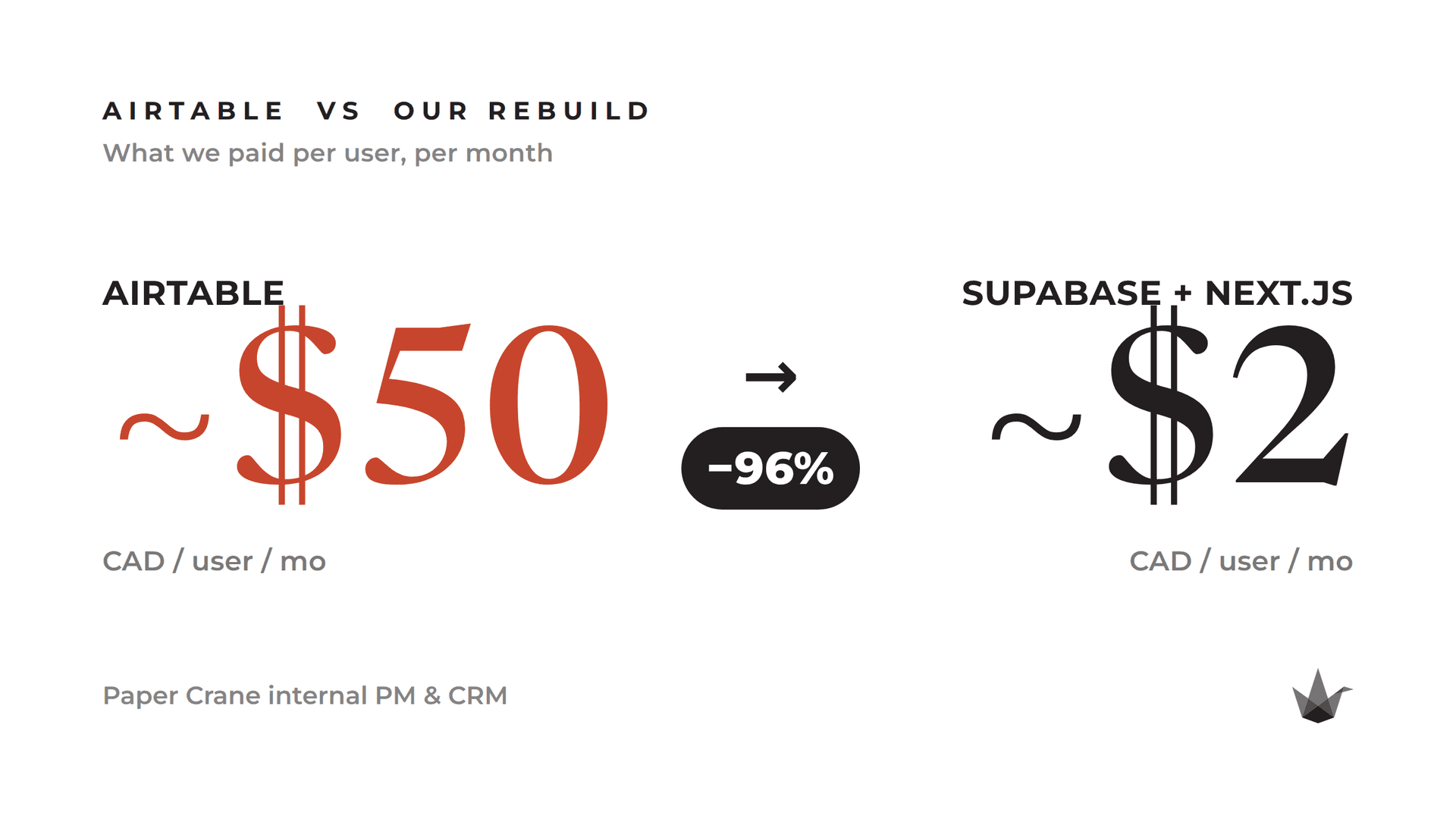
I will put our money where my mouth is. Our internal PM system and CRM used to run on Airtable. Counting the tiers and the seats we carried for people who barely logged in, we were paying around $50 CAD per user per month. Over the holidays we rebuilt it on Supabase and Next.js. We now pay the equivalent of about $2 per user per month, and we lost none of the capabilities Airtable's pricing had been holding hostage. It does more, it costs 96% less, and nobody has to decide whether an 11th teammate is worth a seat.
Now the honest caveat, because I am not going to pretend everyone can do this. We are a software studio. Building things is the job. If you run a 40-person manufacturing company, “just rebuild it” is a useless sentence, and I would be a fraud to hand it to you as advice.
You don't have to build anything to get out from under this, though. Two moves work.
The threat alone disciplines the market. Every vendor now knows rebuilding is a real option for more of their customers than it used to be, and the ones who keep gouging are pricing themselves into a corner. You have more leverage at renewal than you think, so use it.
The other move, and this is what we actually do for most clients, is to replace the bloated per-seat suite you use 5% of with dedicated tools that do the 5% and charge for what you use. We have pulled clients off platforms like HubSpot, where they spent thousands a month to touch a handful of features, onto focused setups that cost a fraction and do exactly their job. Sometimes that is a bespoke build, often it is just picking better-priced software and consolidating the rest. Our ERP-One rebuild is a good look at what happens when a company stops renting its core system by the head.
Per-seat pricing had a good run. It was easy to sell, easy to budget, and easy to abuse, and the abuse is finally catching up with it. Price your software by the value it delivers and I will happily pay more as I use more. Charge me $20 a month so one more person can submit a form, and I will go build the thing myself.