Custom software isn't always the right answer. We'll tell you when it isn't.
Buy when a SaaS product already does what you need and you can live with its rules. A donor CRM, a learning management system or an event platform you rent will usually be cheaper in year one than anything we build.
Configure when a platform you already pay for gets you most of the way. Salesforce, HubSpot, WordPress with the right plugins, or a no-code tool like Airtable can carry a lot of process before it breaks. We often start there, and an Airtable base that works is a good spec for the software that replaces it.
Build when you're paying for modules you don't use, when per-seat fees grow faster than your team, when your data doesn't fit the vendor's model, or when the tool is what you offer your members. RDCK was paying enterprise rates for a proprietary engagement platform and using a handful of its features. We rebuilt those features and their annual running cost fell by more than 95%.
A web application is different from a website in one way: people do things in it. They sign in, submit, search, match, approve and pay, and the data they create has to be stored, permissioned and backed up. That's why web application development is priced and planned like software, not like pages.
Membership websites and client portals
A membership website is the most common thing people ask us for that turns out to be custom software.
For a simple membership site, a platform like Wild Apricot, MemberPress or LearnDash on WordPress is often enough, and we'll set it up that way. It stops being enough when members need different access by role, when the portal has to read and write your CRM, or when the member area is the product: courses, directories, applications, renewals.
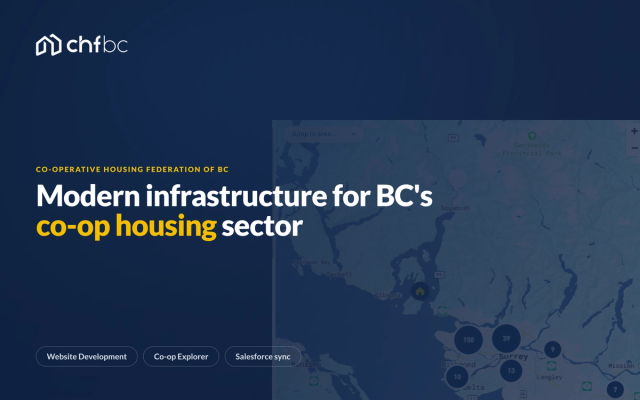
Help for Dementia's learning platform runs on LearnDash with a custom registration and accounts layer on top. CHF BC's Co-op Explorer puts 287 housing co-ops on one map and syncs with Salesforce every day. Pain Connect matches people living with chronic pain to research studies and emails them when a new one fits.
A first release usually takes two to four months. We build in two-week cycles and you use the software on a staging site long before launch.
01
Discovery (weeks 1 to 2)
We sit with the people who will use it, map the process as it runs today and list what the first release must do. You give us the people, the spreadsheets and the tools you use now.
You keep: a written scope, a data model and a fixed price for the first release.
02
Data model and prototype (weeks 2 to 4)
We design the database and click-through screens for the main tasks, and test them with real users before writing production code. You give feedback on the prototype and decide what waits for version two.
You keep: the prototype, the data model and the design files.
03
Build in two-week cycles (weeks 4 to 14)
Every two weeks you get working software on a staging site and a short call to review it. Roles, permissions, emails and integrations come in as each feature does. You test each cycle and tell us what's wrong.
You keep: the code in a repository you own, from the first commit.
04
Data move and launch
We move your existing records from spreadsheets, Airtable or the old system, check them with your team, and launch. You sign off on the migrated data.
You keep: your data in the new system, with its history.
05
Handover and support
Your admins get training and written docs, and we stay on for fixes and the next round of features if you want us. You decide who hosts it.
You keep: admin access, the docs, every login and the running-cost estimate.
Results from software we've built
These numbers come from the published case studies of projects we built.
95%+
Lower annual running cost for RDCK Engage than the platform it replaced
45%
Lower software costs, year over year, for Help for Dementia
287
Housing co-ops on CHF BC's map, synced with Salesforce daily
350+
Locations in Tourism Lethbridge's Explore Lethbridge app
~16 hrs
Admin saved per SocialNext event, on the schedule builder alone
What we settle before writing code
These decide whether the software is still worth having in five years.
Who owns it
The code sits in a repository in your name, and the hosting, domain and third-party accounts are yours. No licence fee to us.
What it costs to run
You get a yearly estimate for hosting, email and any paid services before the build starts.
Where the data lives
We choose hosting with your data in mind, including Canadian regions and Canadian providers when privacy law, a funder or your board needs it.
Who can do what
Roles and permissions are part of the data model from day one: a moderator who can approve posts without touching the rest of the site, for example.
Accessibility
We build to WCAG 2.2 AA and test with automated tools and the keyboard. A formal audit is separate work.
What your team edits
Content your staff change often goes in a CMS they can use without us.
What custom software costs
Most of our web apps and portals cost between $15,000 and $30,000 CAD for the first release. Larger platforms with many integrations or a big data move cost more, and we build those in stages. Registered charities and nonprofits get 10% off.
Users and roles
How many kinds of user there are and what each one can see and do.
Integrations
CRM, payments, email, single sign-on or data feeds the software reads and writes.
Data move
How much existing data comes across, and how clean it is.
Design
Whether it uses your existing brand system or needs its own interface design.
Running costs are separate and depend on the stack. We give you the yearly figure before you sign.
Rob & the rest of the Paper Crane team have been invaluable to our success! They've helped us build our vision from the ground up, and walked us through it every step of the way. They built a sophisticated backend system that orchestrates multiple complex data sources while optimizing it for easy use on the front-end.
Between all the complex features they've built and the seamless Ui/Functionality they've been nothing short of excellent. For anyone needing a development partner who can build complex, multi-source data platforms with user-friendly management interfaces, Paper Crane is the best choice out there!
Jake Austin · Google ·
5 out of 5 stars.
We have been working with Paper Crane for years, and they have been an outstanding partner. They are professional, easy to work with, and consistently deliver high-quality work. Their team brings strong expertise in strategy, design, and digital development.
Paper Crane has supported us across a wide range of projects, including a company rebrand and new logo, a complete website rebuild, a custom knowledge base product, and design improvements for our new software products. Their expertise and approach have made them an invaluable partner to our software company. We look forward to our continued partnership.
Chris Newsome · Google ·
5 out of 5 stars.
We’ve had such a great experience working with the team at Paper Crane! They’ve been instrumental in redeveloping our website and web app, and we truly couldn’t ask for a better partner.
What really sets them apart is how responsive, collaborative, and genuinely invested they are in our success. They take the time to understand our goals, are always quick to help when we need something, and consistently deliver exceptional work.
They really do feel like an extension of our own team rather than an outside agency, and that’s something we value tremendously. Their expertise, creativity, and ongoing support have been invaluable to us. We’re so grateful for the partnership and would highly recommend them to anyone looking for a talented and reliable team!
Dominika Wojcik · Google ·
5 out of 5 stars.
Paper Crane is one of our go-to partners when it comes to custom web development. The team is wonderful to work with, super collaborative, and always on top of the latest tech with great pros/cons lists around various platform options depending on a client's needs. Robert is a great addition to any digital pitch team too as he's able to outline explain tech options in a results-friendly way. And don't even get me started on how awesome their tracksuits are...
It's building software for one organization's process instead of renting a product made for everyone. For us that usually means a web application: a portal, directory, internal tool or new product that runs in the browser, with its own database, roles and integrations.
When is custom software worth it over off-the-shelf?
When you're paying for features you don't use, when per-seat fees grow with every hire, when your data doesn't fit the vendor's model, or when the software is what you offer your members. If a SaaS product or a configured platform does the job, we'll say so.
How much does custom software cost?
Most of our web apps and portals cost between $15,000 and $30,000 CAD for a first release. Larger platforms with many integrations cost more and ship in stages. You get a fixed price after discovery.
How long does an MVP or first release take?
Usually two to four months from discovery to launch. An MVP is scoped to the one job it has to prove, then grows in later releases. Bigger platforms ship in stages, with the first stage live while the next is built.
Who owns the code?
You do. The code is in a repository in your name from the first commit, and the hosting, domain and service accounts are yours. If you move to another developer, they get everything.
What does it cost to run each year?
It depends on the stack and how many people use it, and we give you the figure in writing before the build. RDCK Engage costs more than 95% less to run each year than the platform it replaced.
Can you build a membership website or client portal?
Yes. For a simple membership site we'll often set up a platform like Wild Apricot or LearnDash. When members need different access by role, or the portal has to read and write your CRM, we build the parts the platform can't do.
What's the difference between a web application and a website?
On a website, people mostly read. In a web application they sign in and do things: submit, search, approve, pay. That means a database, permissions, backups and testing, which is why web apps are planned and priced like software.
Can you take over an app someone else built, or replace our Airtable setup?
Yes. We took Tourism Lethbridge's app from another team to launch-ready in a month, and moved SocialNext and MODERNSPEAK off Airtable with their records intact. We start with a review of the code or the base before quoting.
Are you a software development company in Calgary?
Yes, our team is in Calgary. Most of our software clients are elsewhere in Canada, and we work with them by video and on shared staging sites.
Have a process that's outgrown its tools?
Book a 30-minute call with our Calgary team. Tell us what you use now and what it costs, and we'll tell you whether to build, configure or buy.
We use cookies to see how the site is used and to measure our ads. Accept, or decline and we'll keep to the cookies the site needs to work. Privacy policy